
Chapter 7. Altered, corrected and unreadable text
Version 2.0 (16 May 2008). Links updated 12 July 2016.
7.1 Introduction
This chapter deals with the encoding of additions, deletions and corrections made in the manuscript by the scribe or later users, or similar changes made in the transcription, e.g. by the transcriber or encoder of the manuscript text. Further, the chapter deals with the encoding of damage to the manuscript that affects the reading of the manuscript text. In ch. 7.2 corrections, deletions and additions made by the scribe or later users of the manuscript are treated. In ch. 7.3 damage to the manuscript that affects the reading of the manuscript text is treated. Ch. 7.4 treats corrections, deletions and additions made by the transcriber of the manuscript text that have been made e.g. from other text witnesses or earlier editions of the text. Ch. 7.5 contains a summary of all elements and attributes discussed in this chapter.
7.1.1 Structure
Because the features described in this chapter are largely non-linguistic, they have more relevance to the textual levels (encoded by the elements facs, dipl and norm) than to the linguistic encoding of texts, parts of texts, words and so on. In many cases, therefore, the encoding of these features will form an incompatible hierarchy with the structure of the text. In such cases, and in cases where it occurs within a word, the encoder will have to encode the features at a particular textual level. These features will, in general, be marked up at the facs level when they correspond to the physical manuscript. Changes to the text made by the editor/transcriber, on the other hand, should be encoded at the dipl level where necessary. The norm level contains the final, corrected text without non-linguistic markup. The following table indicates at what level each feature should be marked up, and/or its contents included, where relevant:
| Feature | Element | facs | dipl | norm |
|---|---|---|---|---|
| addition in ms. | | text, markup | text | text |
| deletion in ms. | | text, markup | (removed) | (removed) |
| illegible text | | markup | — | — |
| blank space | | markup | — | — |
| unclear text in ms. | | text, markup | text | text |
| text supplied by ed. | | — | text, markup | text |
| error in ms. text | | text, markup | (removed or corrected) | (removed or corrected) |
| text corrected by ed. | | — | text, markup | text |
Here 'Element' also refers to the value of the 'category' attribute when the
element is used (see ch. 7.5).<me:textSpan/>
7.1.2 Elements
The encoding recommended here is based on
ch. 11 “Representation of Primary Sources” of the TEI P5 Guidelines, where the following elements are defined:
| Elements | Contents |
|---|---|
| contains letters, words, or phrases inserted in the manuscript text or in the margins of the manuscript by an author, scribe, annotator or corrector. |
| contains a letter, word or passage deleted, marked as deleted, or otherwise indicated as superfluous or spurious in the manuscript text by an author, scribe, annotator or corrector. |
| indicates a point where material has been omitted in a transcription, normally because the manuscript text is illegible, but potentially for some other reason. |
| indicates a significant or deliberate space in the manuscript. |
| contains a word, phrase or passage which cannot be transcribed with certainty because it is illegible in the manuscript. |
| signifies text supplied by the transcriber, encoder or editor in place of text which cannot be read, either because of physical damage or loss in the original or because it is illegible for any reason. |
| contains text reproduced in the transcription although apparently incorrect or inaccurate. |
| contains the correct form of a passage apparently erroneous in the manuscript text. This element should only be used for corrections made in the transcription or encoding of the manuscript text. It should not be used for corrections made within the manuscript (e.g. by the scribe or a later hand). |
7.1.3 Philological introduction
In a discussion on editorial practice for Old Norse texts Helle Jensen, with reference to Stefán Karlsson 1963, LXVII f., outlines aspects of the manuscript text which should be noted in an edition (Jensen 1988). Jensen's suggestions start with structural markup of e.g. linebreaks in the manuscript. She also gives special signs for each of the features that has to do with scribal or later changes in the manuscript as follows (Jensen 1988, 102 f.):
| Sign | Explanation |
|---|---|
| ` ´ | Includes something that has been added above the line in the manuscript. |
| ´ ` | Includes something that has been added in the margins. Unless stated in a footnote the addition is considered to be the work of the hand that has written the main text. |
| |- -| | Text that has been struck through, underdotted or erased is placed within these brackets. |
| -| |- | Text that has been written twice without being marked by the scribe in the manuscript is placed within these brackets. |
| < > | Text not present in the exemplar, but supplied in the edition by the editor. |
| * | The following word is corrected by the editor. In a footnote the original form is given. |
| [ ] | The text of the manuscript is illegible due to use or damage. The text included could be supplied from another manuscript or be a conjecture made by the transcriber or editor. If the addition is made from another manuscript it should be given diplomatically, if from other sources, such as editions or transcriptions, it should be rendered in a form normalized in accordance with the manuscript text. |
| [[ ]] | Characters within double brackets have been read for the first time in the present transcription. |
| 000 | Unreadable characters or characters lost e.g. through damage to the manuscript. The number of zeros corresponds to the number of characters presumed missing. |
| 000...000 | The number of unreadable characters is not known. |
In addition, Helle Jensen suggests that uncertain readings should be subpunctuated. In editions from the Arnamagnæan Institutes in Reykjavík and Copenhagen these suggestions are in general followed, and in most editions of medieval Scandinavian texts similar systems are used. This gives us a starting point when we are transcribing Old Icelandic and Old Scandinavian manuscripts.
The principles presented in this handbook are based on the tradition of producing scholarly editions of texts and individual manuscripts. The system for printed editions outlined by Helle Jensen can therefore very often be translated into the electronic markup language presented in this chapter.
Text written in the margins can be of various kinds and of varying interest for our knowledge about the main text and the history of the manuscript. Notes on the main text in the margins are of course valuable when we are interested in the text tradition. Other notes could indicate that someone at a certain stage has used it for example in a transcription of the text.
In medieval manuscripts, however, we often also find notes in the margins that have nothing whatsoever to do with the manuscript text. These notes can at first sight seem to be of no value to philological investigation, but in a larger context they can sometimes give information as to where a manuscript has been at a certain stage of its history. If e.g. the same type of scribbles are found in a group of manuscripts where one of the manuscripts can be geographically pin-pointed, this could indicate the whereabouts of the whole group. Information of this kind can also lead to the establishing of new connections between manuscripts that were not previously seen as connected. There are thus good arguments for including information also on this kind of marginal note, but these are more properly contained in the manuscript description in the header (cf. ch. 10.2.2) than within the encoded transcription.
The first kind of notes, i.e. comments or additions to the main text, are often treated in foot-notes in printed editions. They are considered relevant to the reading of the text, and are therefore given in relation to the main text. Marginal notes that indicate the owner or user of the manuscript in any obvious way are often treated in the introduction to the edition as they are considered relevant to the history of the text or manuscript.
The third category of notes, the ones that do not seem to give any relevant information, is often excluded or treated only briefly in the introduction. This is of course a rational way to handle these scribbles when the printed edition sets the limits, and the information often is obscure and cannot be easily related to parallel information concerning other manuscripts. In the electronic transcription of a manuscript, however, there is no reason to make this limitation. The information can be given in the same way as for the other categories, and thereby give us the possibility to search for all kinds of obscure information.
Medieval manuscripts have often become damaged through use, sometimes with relevance for our reading of the text. Pieces of parchment may for example have been torn out, leaving a physical gap in the manuscript. Parts of the text may be illegible because of use or deliberate erasure, or they may be darkened to such an extent that the text is no longer readable. In printed editions, unreadable sections of a text are marked as suggested by Helle Jensen. In the introductions to printed editions problems related to illegible text and damage to the manuscript are often discussed at length. If there are other text witnesses these are often used to replace missing stretches of text. In a diplomatic transcription of a manuscript text, however, the missing or unreadable parts are most often just marked as such. In the following sections the relation between the traditional markup of these kinds of textual and editorial difficulties and electronic encoding will be obvious. It is therefore relevant to take traditional transcription and editing as a starting point for the electronic encoding of transcriptions of manuscript texts.
The primary aim of the following sections are to give recommendations for the transcription and encoding of manuscript texts. It does, however, in some instances also give recommendations for editorial encoding, e.g. markup that refers to corrections or additions made by the transcriber or encoder. It is therefore important to keep the transcription and encoding of the manuscript text on the one hand and on the other hand the editorial changes consistently separated, so that the former provides a starting point for the editorial work.
7.2 Scribal features: Additions, deletions and substitutions
In the manuscript text and in the margins of the manuscript we often
find different kinds of corrections, deletions and additions that we
want to encode. These changes can be divided into different groups
depending on the nature of the change and its relevance for the reading
of the manuscript text or our knowledge about the manuscript. The main
division is between additions or substitutions to the manuscript text,
within the text or in the margins, and deletions made in the manuscript
text. The former should be marked with the
element while
the latter should be marked with the <add>
element. Additions and
substitutions made by the transcriber or editor are treated in the
last section (ch. 7.4).<del>
7.2.1 Additions
This section deals with additions made by a scribal hand only. It is a common mistake to use elements designed for this purpose to mark up additions made by an editor - such features are covered below in ch. 7.4.
The following elements are recommended for describing additions made by the
author of the text, a compiler, scribe, annotator or corrector in the
manuscript text. The TEI P5 Guidelines recommend the use of the
element to describe additions in the manuscript (ch. 11.3). In the following
the use of <add>
in relation
to our recommended encoding of the individual word within the element
<add>
and on the three different levels
<w>
, <me:facs>
and
<me:dipl>
is treated.<me:norm>
| Elements | Contents |
|---|---|
| Contains letters, words or phrases inserted in the manuscript text or in the margins of the manuscript by an author, scribe, annotator or corrector. Attributes include: |
| Signifies the agent which made the addition. The value is an XML IDREF, referring to a |
| Signifies the transcriber or editor responsible for identifying the hand. The value is an XML IDREF, referring to an agent described in the header (cf. also ch. 10). |
| Indicates where the addition is made. Suggested values include: |
| The addition is made in a space originally left empty by the scribe. |
| The addition is made above the line. |
| The addition is made below the line. |
| The addition is made in the left margin. |
| The addition is made in the right margin. |
| The addition is made in the top margin. |
| The addition is made in the bottom margin. |
| The addition is made on the next page. |
| The addition is made on the previous page. |
Additions which can be ascribed to the author of a text are rare in
medieval Nordic manuscripts. The additions being described with the
above-mentioned attribute
will therefore primarily be
ascribed to the values @hand
, "scribe"
,
"compiler"
or "annotator"
. Scribal additions are probably the
most common changes to be recorded in the transcription and encoding
of a manuscript text. The list of hands in the header (cf.
ch. 10) should identify the
individual hand, either as anonymous or, if possible, by name. The
main hand in a manuscript will normally be marked as "corrector"
."mainscribe"
If the addition consists of a
series of complete words, the
tag should be
surrounding the word(s). The following example contains a marginal addition:<add>

Here (AM 748 I b 4to, fol. 18r, ll. 5-7) the scribe
(identified as
in the header)
has inserted the word 'sigavtr' in the left margin (now
partially cut off by the binding) with a mark after 'skollvalldr'.
It should be encoded as follows. Because the addition is a whole word, the
tag should enclose the word (Note that for
the sake of clarity we have limited the use of encoding to the relevant
sequence and simplified the orthography):"mainscribe"
<!-- after skollvalldr -->
<add place="left" hand="mainscribe">
  <w>
    <choice>
      <me:facs>sig&avlig;tr</me:facs>
      <me:dipl>sig&avlig;tr</me:dipl>
    </choice>
  </w>
</add>
Note that to ensure correct rendering of the addition, no space is
included between the
and
<add>
elements.<w>
In cases where the addition forms part of a word, the markup should normally be restricted to the facsimile level. In any case, the addition need not be marked up as part of the normalised text. Cf. the following:

annat af
<w>
<me:facs><add hand="scribe" place="supralinear">v</add>
ręriligv<am>&bar;</am></me:facs>
<me:dipl>vręriligv<ex>m</ex></me:dipl>
<me:norm>uhræriligum</me:norm>
</w>
annat The location of the addition in the above markup is indicated by the
attribute
; in this case, the addition is made above the line of
the manuscript text and therefore uses the value @place
."supralinear"
The diplomatic and normalised text will normally include the addition if made by a scribal hand. Additions made by later hands will normally be omitted from the diplomatic and normalised text without markup.
Additions are sometimes made by an annotator, i.e. comments to the text. This kind of additions could be encoded as the marginal note “vantar ekkert F. J.” by Finnur Jónsson in Codex Wormianus (AM 242 fol. p. 60):
<add hand="FJ">
<w><me:facs>vantar</me:facs></w>
<w><me:facs>ekkert</me:facs></w>
<w><me:facs>F˙</me:facs></w>
<w><me:facs>J˙</me:facs></w>
</add> It is also possible to indicate
with the attribute
where on the manuscript page the
annotation is made. Finnur Jónsson's annotation is made
in the bottom margin, and should be encoded as follows:@place
<add hand="FJ" place="bottom">
<w><me:facs>vantar</me:facs></w>
<w><me:facs>ekkert</me:facs></w>
<w><me:facs>F˙</me:facs></w>
<w><me:facs>J˙</me:facs></w>
</add> Changes in scribal hands are not considered additions. For the markup of
such phenomena, use the empty
element. Note that this element is parallel to empty elements like <handShift/>
, <pb/>
and <cb/>
in that it only points to a break in the text (cf. the discussion in ch. 4.7 and ch. 4.10 above).<lb/>
See §7.5 below for examples of how to mark up additions which
span linguistic (
, etc.) boundaries.<w>
7.2.2 Deletions
This section deals with deletions made by a scribal hand only. Text supressed by the editor is dealt with under 'corrections' (ch. 7.4.2) below.
The TEI P5 Guidelines specify the use of the
element to describe additions in the manuscript
(ch. 11.3).
In the following the use of <del>
in relation to our
recommended encoding of the individual word within the element
<del>
and on the three different levels
<w>
, <me:facs>
and
<me:dipl>
is treated.<me:norm>
| Elements | Contents |
|---|---|
| Contains a letter, word or passage deleted, marked as deleted, or otherwise indicated as superfluous or spurious in the manuscript text by an author, scribe, annotator or corrector. Attributes include: |
| Signifies the agent which made the deletion. The value is an XML IDREF, referring to a |
| Signifies the editor or transcriber responsible for identifying the hand of the restoration. The value is an XML IDREF, referring to an agent described in the header (cf. ch. 10). This information can also be given in the header. |
| Display rendering information in TEI. This attribute is used here speficially to classify the deletion as displayed, using any convenient typology. Sample values include: |
| The text has been struck through. |
| The text has been erased. |
| Deletion indicated by brackets in the text or margin. |
| Deletion indicated by dots beneath the letters deleted. |
Deletions that can be ascribed to the author of a manuscript text are
rare in medieval Nordic manuscripts. The deletions being described
with the above mentioned attribute
will therefore
primarily be ascribed to @hand
or
"scribe"
."corrector"
Deletions should normally only be marked up at the 'facs' level. The text should be removed without indication at the other textual levels.
The example in ch. 7.2.1 (Figure 7.1) contains the word 'skolldvalldr' in which the first 'd' is marked with a dot below signifying deletion. It should be marked up as follows:
<w>
  <choice>
    <me:facs>&slong;koll<del hand="mainscribe" rend="subpunction">d</del>
      valld&rrot;</me:facs>
    <me:dipl>&slong;kollvalld&rrot;</me:dipl>
  </choice>
</w>
Deletions of one or more words made by the scribe(s) or
corrector(s) of a manuscript are encoded as in the passage from
the Third Grammatical Treatise below. Note that we for clarity
limit the use of encoding to the relevant manuscript line, and that only the
and <me:facs>
levels are shown, and a few of the
words have been suppressed.<me:dipl>

<lb n="94:12"/>
<w>
  <choice>
    <me:facs>liflau<lb/>sum</me:facs>
    <me:dipl>liflausum</me:dipl>
  </choice>
</w>
<w>
  <choice>
    <me:facs>lvtv<am>&bar;</am>.</me:facs>
    <me:dipl>lvtv<ex>m</ex>.</me:dipl>
  </choice>
</w>

<del hand="mainscribe" rend="overstrike">
<w>
  <choice>
    <me:facs>v<am>&er;</am>rðr</me:facs>
    <me:dipl>v<ex>er</ex>ðr</me:dipl>
  </choice>
</w>
<w>
  <choice>
    <me:facs>an<am>&bar;</am>at</me:facs>
    <me:dipl>an<ex>n</ex>at</me:dipl>
  </choice>
</w>
<!-- skipping: 'af liflausum lutum. enn annat af lifligum lutum' ... -->
<w>
  <choice>
    <me:facs>lvtv<am>&bar;</am>.</me:facs>
    <me:dipl>lvtv<ex>m</ex>.</me:dipl>
  </choice>
</w>
</del>

<w>
  <choice>
    <me:facs>Hlioð</me:facs>
    <me:dipl>Hlioð</me:dipl>
  </choice>
</w>
<w>
  <choice>
    <me:facs>þ<am>&bar;</am></me:facs>
    <me:dipl>þ<ex>at</ex></me:dipl>
  </choice>
</w>
<w>
  <choice>
    <me:facs>hæyriz</me:facs>
    <me:dipl>hæyriz</me:dipl>
  </choice>
</w>
In the TEI P5 Guidelines cited above
there are a number of possible types of deletion described with the
attribute
. These could be applied to deletions made both
by scribe(s) and corrector(s). If a deletion is made e.g. by
@type
the deleted text it could be encoded as (here
only presented on the "overstriking"
level):<me:facs>
en tuenner flokkar þeirar þioðar er<lb n="3r:15"/>
<del hand="mainscribe" rend="overstrike">
  <w>
    <me:facs>liguri</me:facs>
  </w>
  <w>
    <me:facs>hæita</me:facs>
  </w>
  <w>
    <me:facs>er</me:facs>
  </w>
</del>
traceum hæiter.
This could then be displayed on the computer screen or in a printed edition in the manner suggested above (ch. 7.1):
14   ...en tuenner flokkar þeirar þioðar er
15   |-liguri hæita er-| traceum hæiter...
The text that is marked as deleted
must be at least partly legible in the manuscript so that it can be
read by the transcriber. If the deleted text is not legible the
deletion should be marked up with the
element,
described below (7.3.1). The <gap/>
element could be
enclosed in the <gap/>
element to indicate that the gap
is in some way intentional. Parts of the deleted text that are
legible could be indicated by the <del>
element in
combination with the <unclear>
element as described below
(ch. 7.3.2).<gap/>
As for the markup of additions using
, if the
deletion is of part of a word, it should normally only be marked up at the
<add>
level. If the deletion is by a scribal hand,
the deleted text will be omitted from the <me:facs>
and <me:dipl>
levels without markup.<me:norm>
In some cases, the deletion will conflict with word boundaries. ch. 7.5 below describes how to mark up such deletions.
7.2.3 Substitutions
This section describes the markup of text substituted by a scribe,
that is, where a scribe deletes text and replaces it with some other
text. In medieval manuscripts a rather
common phenomenon is the combination of deleted text and added text.
It is not always possible, however, to ascertain the relation between
the two. If someone has deleted the originally written text inline
this does not automatically mean that a corresponding addition above
the line or in the margin is made by the same scribe. It can
therefore not be stated as certain whether the correspondence is
intentional or not. There is no specific element for this type of
feature. We suggest that substitutions made in the
manuscript should be marked primarily with the two core tags
and <del>
.
In cases where we can be
relatively sure about the agent of the whole substitution this could
be indicated with a combination of the <add>
and the
<del>
elements as illustrated below.<add>

Here, the seventh word 'barv' has been altered by the scribe, such that the original 'a' at the end of the word is marked as deleted by subpunctuation and a 'u' has been added as the replacement letter above the line. This word should be marked up as follows (facs and dipl levels only):
<w>
  <choice>
    <me:facs>bar<del hand="mainscribe" rend="subpunction">a</del>
      <add hand="mainscribe" place="supralinear">v</add></me:facs>
    <me:dipl>barv</me:dipl>
  </choice>
</w>
As for the
and <del>
elements, markup within words
should only be included at the facs level, and the dipl and norm levels should
include the text which the scribe(s) appears to have intended, as in the
example above.<add>
The same type of markup can be used for substitutions which span structural boundaries. This type of markup is discussed in more detail in ch. 7.5.
7.3 Damage and illegibility
The following section deals with text omitted in the transcription or editing of text due to damage or illegibility in the manuscript, and text supplied from other sources such as other text witnesses or earlier editions.
The following detail of a manuscript page will serve to illustrate the markup in the following sections.
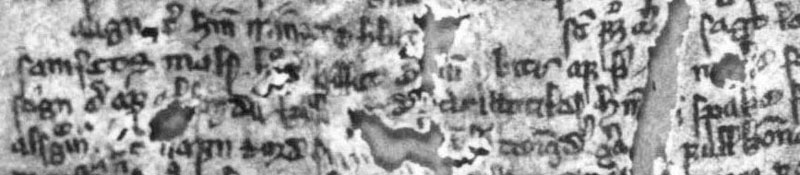
7.3.1 Text omitted from the transcription
When the manuscript is illegible we
suggest the use of the elements
and
<gap/>
to indicate the illegible text, its extension
and how it has been supplied (for the <supplied>
element
see ch. 7.4.1). The <supplied>
element is used to represent deliberate omissions from the manuscript which
have some significance, e.g. spaces left for decorated initials or words.<space/>
| Elements | Contents |
|---|---|
| Is an element without extention in the encoded manuscript text. It indicates a point where material has been omitted in a transcription because the manuscript text is illegible. Attributes include: |
| Gives the reason for omission. Sample values include: 'sampling', 'illegible', 'irrelevant', 'cancelled', 'cancelled and illegible'. |
| Indicates approximately how much text has been omitted from the transcription, in the way that has been suggested by Helle Jensen refered to above (ch. 7.1). Values can be given as e.g. number of signs, number of lines or number of pages in the manuscript. |
| Indicates the transcriber, encoder or editor responsible for the decision not to provide any transcription and hence the application of the |
| In instances where text is omitted from the transcription because of deliberate deletion by an identifiable hand, this attribute signifies the hand which made the deletion. |
| In the case of text omitted because of damage, categorizes the cause of the damage, if it can be identified. |
| Is an element without extention in the encoded manuscript text. It indicates a point in a transcription of a manuscript where the mansucript has a deliberate omission. Attributes include: |
| The extent of the space. Values can be given as e.g. number of signs, number of lines or number of pages in the manuscript. |
| Names the unit used for describing the extent of the gap. |
In medieval manuscripts we often
find sections that for some reason are illegible. This can be due to
e.g. damage or use. In the transcription we primarily wish to
register the sections that are illegible and the extent of the
illegibility. We suggest that the illegible sections should be
indicated by the
element. The extent of the
illegible section could be encoded as the following text from
the manuscript above, where wearing has occurred next to a
hole (bottom left of image):<gap/>
<w>
  <choice>
    <me:facs>m<lb n="25"/>al&slong;g<am>&esup;</am>in<am>&rsup;</am>
      </me:facs>
    <me:dipl>m<lb n="25"/>al&slong;g<ex>re</ex>in<ex>ar</ex></me:dipl>
  </choice>
</w>
<!-- we know from the other mss that a whole word is missing -->
<w>
  <choice>
    <me:facs><gap /></me:facs>
    <me:dipl><!-- we can insert text here - see below --></me:dipl>
  </choice>
</w>
<w>
  <choice>
    <me:facs>nafn</me:facs>
    <me:dipl>nafn</me:dipl>
  </choice>
</w>
With this markup the extent of the illegible section is not defined. It can be presented on the computer screen or in a printed edition in the manner suggested above (ch. 7.1):
malsg(re)in(ar) 00...00 nafn
If the transcriber or encoder of
the text wishes to define the section more accurately it can be done
as in the following example. The number of missing signs is given as
a value to the attribute
. It should be noted that the
number given in the example is not intended as an exact evaluation of
the number of signs missing in the present manuscript.@quantity
<w>
  <choice>
    <me:facs>m<lb n="25"/>al&slong;g<am>&esup;</am>in<am>&rsup;</am>
      </me:facs>
    <me:dipl>m<lb n="25"/>al&slong;g<ex>re</ex>in<ex>ar</ex></me:dipl>
  </choice>
</w>
<!-- we know from the other mss that a whole word is missing -->
<w>
  <choice>
    <me:facs><gap extent="2"/></me:facs>
    <me:dipl><!-- we can insert text here - see below --></me:dipl>
</choice>
</w>
<w>
  <choice>
    <me:facs>nafn</me:facs>
    <me:dipl>nafn</me:dipl>
  </choice>
</w>
This could be represented as follows on the computer screen or in a printed edition. As the accuracy of this kind of evaluation is questionable it should not have the highest priority to display this in e.g. a printed edition.
malsg(re)in(ar) 00 nafn
See below (ch. 7.4.1) for an example of text
supplied in place of the gap by the editor using the
element.<supplied>
A deliberate space in a manuscript should be indicated by the
element. For example, in the image above, an initial letter has been
omitted, presumably for a coloured or decorated initial to be added later. This is encoded
as follows:<space/>
<lb/><w>
<!-- initial 'S' is left blank by the scribe here -->
  <me:facs><space quantity="1" dim="horizontal"/>augn</me:facs>
</w>
In this example, the text has only been encoded on the facs level, so the
element would be redundant.<choice>
If the text omitted in the space is supplied using the
element, the <supplied>
tag will normally be used at the facs level and
the <space/>
element will be used at the dipl
level (with the <supplied>
attribute set). See
ch. 7.4.1.@reason="space"
7.3.2 Uncertain readings in the manuscript
In medieval manuscripts we often encounter problems of illegibility due to
use or damage. In the following the encoding of such sequences is treated. To
some extent this has already been treated in the above section
(ch. 7.3.1). In cases where the text is readable to some
extent the
and <gap/>
elements should not be used. The TEI P5 Guidelines (ch. 11.5
of the TEI P5 Guidelines) recommend that
the <supplied>
element is used for encoding damage and
illegibility where the text of the damaged or illegible area can be read with
some, but not full, certainty.<unclear>
| Elements | Contents |
|---|---|
| Contains a letter, word, phrase or passage which cannot be transcribed with certainty because it is illegible in the manuscript text. Attributes include: |
| Indicates why the material is hard to transcribe. |
| Indicates the individual responsible for the transcription of the letter, word, phrase or passage contained within the |
| Signifies the hand responsible for the action where the difficulty in transcription arises from action (partial deletion, etc.) assignable to an identifiable hand. Note that this attribute has the same function in the |
| Where the difficulty in transcription arises from an identifiable cause, signifies the causative agent. |
| Indicates how the element in question was rendered or presented in the source text. |
The example given above from AM 757 a 4to includes a section on the second line which can only be partially read. The following is the encoding for the section, only represented at the facs level:
<w>
  <me:facs>mal&slong;</me:facs>
</w>.
<w>
  <me:facs>h<am>&osup;</am></me:facs>
</w>
<w>
  <me:facs><gap extent="2"/></me:facs>
</w>
<unclear reason="worn" resp="TW">
<w>
  <me:facs>k&ocurl;llut</me:facs>
</w>
<w>
  <me:facs>ein<am>&bar;</am></me:facs>
</w>
<w>
  <me:facs>hlutr</me:facs>
</w>
</unclear>
<w>
  <me:facs>af</me:facs>
</w>
The text may also include fully illegible text, as represented above with the
element. With this encoding the text could
be presented with subpunction or as grey text for all the words that the editor can
not read with absolute certainty.<gap/>
7.4 Editorial interventions
When transcribing medieval material
we often encounter words or longer sequences of text that we consider
corrupt in one way or another. Sometimes it may also be obvious that
text is missing in the manuscript we are transcribing or that the
scribe has made a mistake. The transcriber of the manuscript text may
in these instances wish to indicate the mistake or even correct the
text, either directly from other versions of the same text or based
on already existing editions of the text. Sometimes the transcriber
or editor may also wish to make obvious grammatical corrections in
the text without having any other text witness or precedence in an
earlier edition. In the following the encoding of corrections made by
the transcriber of the text or by an editor are treated. Note that we
do not recommend the use of the attribute
for the changes
made in transcription or encoding of the manuscript text. The
attribute @hand
should be used consistently for corrections or
additions made in the transcription or encoding of the text to
distinguish clearly between what is found in the manuscript text and
what is made in the transcription and encoding of the text.@resp
7.4.1 Additions made by the transcriber or editor
If text is obviously missing in the
manuscript text we may wish to supply it. This could be based on, for
example, another text witness or on a earlier edition of the text. The
markup of such additions should give information about the source as
well as about the responsibility for the addition. To encode
additions made in the transcription we recommend the use of the
element as described in the TEI P5 Guidelines
(ch. 11.3.7). In the following
the use of <supplied>
in relation to our recommended
encoding of the individual word within the element <supplied>
and on the three different levels <w>
,
<me:facs>
and <me:dipl>
is treated.<me:norm>
| Elements | Contents |
|---|---|
| Signifies text supplied by the transcriber, encoder or editor in place of text which cannot be read, either because of physical damage or loss in the original or because it is illegible for any reason. Attributes include: |
| States the source of the supplied text if this can be located. |
| Indicates the individual responsible for the addition of letters, words or passages contained within the |
| The person responsible for the transcription of the manuscript text. |
| The person responsible for the encoding of the manuscript text. |
| The editor of the text used for the addition or responsible for the addition in editing the manuscript text. |
| Indicates why the text has had to be supplied |
| Where the presumed loss of text leading to the supplying of text arises from an identifiable cause, signifies the causative agent. |
If the transcriber or editor wishes
to supply text that is missing in the transcribed manuscript text
from for example another text witness, this can be handled with the
element. The interpolated text could be
transcribed as in this instance from the detail of AM 757 a 4to above.
Note that we for clarity limit the use of encoding to
the relevant sequence:<supplied>
<w>
<choice>
<me:facs>m<lb n="25"/>al&slong;g<am>&esup;</am>n<am>&rsup;</am>
</me:facs>
<me:dipl>m<lb n="25"/>al&slong;g<ex>re</ex>n<ex>ar</ex></me:dipl>
</choice>
</w>
<w>
<choice>
<me:facs><gap extent="2"/></me:facs>
<me:dipl><supplied resp="TW" source="AM 748 I b 4to">þat
</supplied></me:dipl>
</choice></w>
<w>
<choice>
<me:facs>nafn</me:facs>
<me:dipl>nafn</me:dipl>
</choice>
</w>This could then be displayed on the computer screen or in a printed edition in the manner suggested above (ch. 7.1):
malsg(re)n(ar) <þat> nafnIn the above example there are other sources available for the illegible
text. This kind of editorial change is,
however, not suggested as compulsory. In a primary transcription and
encoding the use of the
element should only give
the essential manuscript information. The attributes to
<gap/>
and <gap/>
, such as
<supplied>
or @source
, can of course be included voluntarily
and to the extent that information is available.@resp
7.4.2 Deletions made by the transcriber or editor
If a piece of text obviously should be deleted, e.g. duplicated text in a dittography, the transcriber or editor might want to make a deletion. This is the converse action of adding text, and should be distinguished from similar actions made by the scribe. While the elements
and <add>
describe actions by the scribe himself or other scribes, the editorial additions and deletions should be singled out by separate elements. For additions, TEI recommends the element <del>
, but there is no parallel to the <supplied>
element. We suggest the element <del>
, since the noun expunction and the verb expunge are commonly used for editorial deletion.<me:expunged>
| Elements / attributes | Contents |
|---|---|
| Contains text which the transcriber or editor believes should be expunged. |
| Indicates the individual responsible for the expunction of letters, words or passages contained within the |
| The transcriber responsible for the expunction. |
| The encoder responsible for the expunction. |
Note that expunged text will not be deleted from the transcription, but will be contained by the
element. The editor of the text may decide to dsiplay it with no comments, put it in brackets or suppress it. In a multi-level transcription, expunction will typically not be found on the <me:expunged>
and <me:dipl>
levels, but not on the <me:norm>
level.<me:facs>

In this example from Niðrstigningar saga, AM 233 a fol, the word “menn” has been supplied and thereafter the duplicated word “mæla” has been expunged:
<w>
<choice>
<me:facs>þ<am>&bar;</am>t</me:facs>
<me:dipl>þ<ex>uia</ex>t</me:dipl>
</choice>
</w>
<w>
<choice>
<me:facs>þ<am>&bar;</am>r</me:facs>
<me:dipl>þ<ex>ei</ex>r</me:dipl>
</choice>
</w>
<w>
<choice>
<me:facs>villdu</me:facs>
<me:dipl>villdu</me:dipl>
</choice>
</w>
<w>
<choice>
<me:facs>ecki</me:facs>
<me:dipl>ecki</me:dipl>
</choice>
</w>
<w>
<choice>
<me:facs>v<am>&dsup;</am></me:facs>
<me:dipl>v<ex>id</ex></me:dipl>
</choice>
</w>
<w>
<choice>
<me:facs></me:facs>
<me:dipl><supplied resp="OEH" source="AM 645 4to">menn</supplied>
</me:dipl>
</choice>
</w>
<w>
<choice>
<me:facs>mæla</me:facs>
<me:dipl>mæla</me:dipl>
</choice>
</w>
<lb n="40"/>
<w>
<choice>
<me:facs>mæla</me:facs>
<me:dipl><me:expunged>mæla</me:expunged></me:dipl>
</choice>
</w>Depending on the style sheet, the diplomatic text might be displayed this way:
þuiat þeir villdu ecki vid <menn> mæla -|mæla|-
7.4.3 Corrections
In the manuscript it is not always
possible to say anything with certainty about the intention of
changes in the text. When transcribing the text, however, corrections
of obvious mistakes in the manuscript text could be marked with the
following tag set recommended in the TEI P5 Guidelines
(ch. 11.3). In the following the use of
and
<sic>
in relation to
our recommended encoding of the individual word within the element
<corr>
and on the three different levels
<w>
, <me:facs>
and
<me:dipl>
is treated.<me:norm>
| Elements / attributes | Contents |
|---|---|
| Contains text reproduced although apparently incorrect or inaccurate. |
| Contains the correct form of a passage apparently erroneous in the manuscript text. |
| Indicates the individual responsible for the correction of letters, words or passages contained within the |
| The person responsible for the transcription of the manuscript text. |
| The person responsible for the encoding of the manuscript text. |
| Signifies the editor responsible for suggesting the correction. |
| Indicates how the element in question was rendered or presented in the source text. |
In a first-level transcription it
can be relevant just to mark the obviously corrupted instances in the
manuscript text. This could be done with the
element as in this instance from AM 242 fol:<sic>

Here the second numeral '.xij.' is written instead of '.ix.', obvious from the context and other manuscripts. The error should be signalled at the facs level and corrected at the dipl level:
<w>
  <choice>
    <me:facs>en<am>&bar;</am></me:facs>
    <me:dipl>en<ex>n</ex></me:dipl>
  </choice>
</w>
<num>
  <choice>
    <me:facs>.viij.</me:facs>
    <me:dipl>.viij.</me:dipl>
  </choice>
</num>
<w>
  <choice>
    <me:facs><am>.</am>e<am>.</am></me:facs>
    <me:dipl>e<ex>ða</ex></me:dipl>
  </choice></w>
<num>
  <choice>
    <me:facs><sic>.xij.</sic></me:facs>
    <me:dipl><corr>.ix.</corr></me:dipl>
  </choice>
</num>
With this markup it is possible to show the text on the computer screen or in a printed edition in accordance with the suggestions above (ch. 7.1):
en(n) .viij. e(ða) *.ix.with the corrected form from the manuscript text underneath the edited text:
* .xij. It is also possible to include
information about the person responsible for the correction with the
attribute
and its values.@resp
In this example of a multi-level transcription, the
element lies on the facs level, while the <sic>
element is introduced on the dipl level, and perhaps silently on the norm level. In a single-level transcription (cf. ch. 3.3), the <corr>
element should be used to group the <choice>
and <sic>
elements. If, for example, a source has the reading<corr>
Please look left now!
in which “left” should be corrected to “right”, this would be the appropriate encoding:
Please look <choice><sic>left</sic><corr>right</corr></choice> now!
In a single-level transcription, the
element thus groups <choice>
and <sic>
elements, while in a multi-level transcription it groups readings on different levels, i.e. the <corr>
, <me:facs>
and <me:dipl>
elements. The <me:norm>
element is simply a neutral mechanism to group alternative readings.<choice>
7.5 Reference: elements and attributes
Because of the large number of elements and attributes introduced in this chapter, the following reference material is supplied.
7.5.1 Elements
The following is a list of elements to encode non-linguistic features. In the table, 'level' indicates the textual level at which the feature should be encoded, if it occurs within a word. No such features should be encoded at the 'norm' level, as this level should not include non-linguistic aspects of the text. Some elements are included which are not treated in this chapter. Encoders should refer to the TEI P5 guidelines for more information.
| element | level | section | description | attributes |
|---|---|---|---|---|
| facs | 7.2.1 | addition made by scribe outside the normal flow of text | type, hand, place, resp, cert |
| dipl | 7.4.3 | corrected text inserted by editor | resp, cert |
| facs | N/A | physical damage to the ms | type, hand, extent, agent, degree, resp |
| facs | 7.2.2 | deletion made by the scribe | type, hand, resp, cert, status |
| dipl | 7.4.2 | identified by editor to be supressed: spurious or superfluous | type, resp |
| facs, dipl | 7.3.1 | illegible text in ms | type, hand, extent, agent, reason, resp |
| facs | N/A | text deleted and then restored | type, hand, resp, cert |
| facs | 7.4.3 | incorrect text to be marked as such | |
| facs | 7.3.1 | deliberate space in ms | extent, dim, resp |
| dipl | 7.4.1 | text supplied by the editor | type, hand, agent, reason, source, resp |
| facs | 7.3.2 | unclear or partially legible text | hand, agent, reason, resp, cert |
7.5.2 Descriptive attributes
The following attributes have similar meanings, regardless of which element they are used with.
| attribute | used with | content |
|---|---|---|
| damage, gap, supplied, unclear | The cause of damage or illegibility in the ms. Suggested values include 'hole', 'cut off', 'worn'. |
| add, corr, del, restore, unclear | The degree of certainty of the editor in identifying the feature being marked up. |
| damage | The extent to which the ms is damaged. This attribute should only be used where the text may be read with some confidence. |
| space | Indicates whether the space is horizontal or vertical. Only two possible values: 'horizontal' or 'vertical'. |
| damage, gap, space | The physical extent of the feature. An integer representing the approximate number of letters is the recommended unit, although millimetres, minims or other units may also be used. |
| add, damage, del, gap, restore, supplied, unclear | The hand responsible for the feature encoded, or in the case of supplied text, the hand responsible for the feature which necessitates the supplied text. This attribute is in the form of an IDREF to an entry in the handDesc in the header. |
| add | The location of the addition made by the scribe. Suggested values include 'inline' (a space originally left by the scribe), 'supralinear' (above the line), 'infralinear' (below the line), 'left' (in the left margin), 'right' (in the right margin), 'top' (in the top margin), 'bottom' (in the bottom margin), 'verso' (overleaf). |
| gap, supplied, unclear | The reason for the gap, unclear text or supplied text in the ms. Suggested values: 'sampling', 'illegible', 'irrelevant', 'cancelled'. |
| (all) | Information on how the element is rendered in the source text. This attribute should not be used where the 'type' attribute is more appropriate. |
| add, corr, damage, del, expunged, gap, restore, space, supplied, unclear | The editor or transcriber responsible for identifying and describing the feature encoded; or (in the case of expunged, corr, supplied) supplying or altering the text. This attribute is an IDREF referring to the teiHeader. |
| supplied | The source of the supplied text, for example, another manuscript or an edition. |
| del | May be used to indicate faulty deletions, e.g. strikeouts which include too much or too little text. |
| add, damage, del, expunged, gap, restore, supplied | The type of feature being encoded. The typology relates to the element itself, for example 'del' may use the values 'subpunction' or 'strikethrough'. |