
E. Menota header
Version 2.0 (16 May 2008). Links updated 12 July 2016.
E.1 Introduction
We recommend that all texts in the Medieval Nordic Text Archive contain a minimal amount
of information about the text, its background and its encoding. This should be entered in
the
, which is an integral and essential part of any XML/TEI document.<teiHeader>
Below are two examples of headers for Medieval Nordic texts. The first example is of a header for a primary source with only a single text; the other for a source with more than one text.
A header may contain much more information than exemplified here. What we have specified in these examples is the recommended minimum amount of information.
Cf. the TEI P5 Guidelines ch. 2 “The TEI Header” for a discussion of headers in general and also the notion of minimal and recommended headers (ch. 2.6).
Important! Note that both headers will only be valid when using a Menota DTD schema. If you would like to use a RELAX NG schema you must add the Menota namespace to the very first line, as explained in ch. 1.9 and Appendix D.2:
<TEI xmlns="http://www.tei-c.org/ns/1.0" xmlns:me="http://www.menota.org/ns/1.0">The list in ch. 1.9 is a complete list of elements and attributes belonging to the Menota namespace. They must all be prefixed by “me:” when using a RELAX NG schema.
E.2 Minimal header for a single-text source
Although many medieval manuscripts contain more than one text, there are some manuscripts which only contain a single piece of text. That is also generally true of charters (diplomas). We have chosen Holm perg 6 fol (also referred to as Sth. perg. fol. nr 6) as an example of a single-text source. This manuscript carries the text of Barlaams ok Josaphats saga, although with some parts missing.
Please note that the distinction between single-text and multi-text sources is not straightforward and ultimately rests on the definition of key concepts such as “text” and “work”. If in doubt, we recommend using the established categories in catalogues and indices, e.g. the index volume of Ordbog over det norrøne prosasprog (Copenhagen 1989).
We have chosen Holm perg 6 fol also in order to demonstrate how a cumulative process of text encoding can be documented. This text was initially transcribed and edited in an electronic version by Magnus Rindal in the late 1970ies (the printed edition in 1981 was generated from this file). Subsequently, Jon Erik Hagen and Odd Einar Haugen lemmatised the text, i.e. added information about lemma and grammatical form for each running word. Finally, Christian-Emil Ore converted the file from its original customised format into Menotic XML. Thus, four people have contributed to the making of the present electronic version of the text, and should be credited accordingly.
<TEI xmlns="http://www.tei-c.org/ns/1.0">
  <teiHeader xml:lang="eng">
    <fileDesc>
      <titleStmt>
        <title>Holm perg 6 fol (Barlaams ok Josaphats saga):
          an electronic edition</title>
        <respStmt>
          <resp>Edition by </resp>
          <name>Magnus Rindal
            <orgName type="affiliation">University of Bergen</orgName>
          </name>
        </respStmt>
        <respStmt>
          <resp>Lemmatisation and morphological encoding by </resp>
          <name>Jon Erik Hagen
            <orgName type="affiliation">University of Bergen</orgName>
          </name>
          <name>Odd Einar Haugen
            <orgName type="affiliation">University of Bergen</orgName>
          </name>
        </respStmt>
        <respStmt>
          <resp>Conversion to Menotic XML by </resp>
          <name>Christian-Emil Ore
            <orgName type="affiliation">University of Oslo</orgName></name>
        </respStmt>
      </titleStmt>
      <editionStmt>
        <p>First draft, <date when="2004-02-01">1 February 2004</date>
        </p>
      </editionStmt>
      <publicationStmt>
        <distributor>Medieval Nordic Text Archive</distributor>
        <idno type="Menota">Ms. 1</idno>
        <date when="2004-03-01">1 March 2004</date>
        <availability status="restricted">
          <p>This text is available for purposes of academic research
            and teaching only. Re-distribution in any form without prior
            permission is prohibited. Short extracts may be cited with
            full acknowledgment of the source.</p>
        </availability>
      </publicationStmt>
      <sourceDesc>
        <msDesc>
          <msIdentifier>
            <country  key="SE">Sweden</country>
            <settlement>Stockholm</settlement>
            <repository>Kungliga Biblioteket</repository>
            <idno>Holm perg 6 fol</idno>
            <msName>Barlaams ok Josaphats saga</msName>
          </msIdentifier>
          <msContents>
            <msItem n="1">
              <locus from="1r" to="102v">ff. 1r–102v (pp. 1–204)</locus>
              <title type="main">Barlaams ok Josaphats saga</title>
              <title type="abbreviated">Barl</title>
              <textLang mainLang="onw">Old Norwegian</textLang>
            </msItem>
          </msContents>
          <physDesc>
            <objectDesc form="codex">
              <supportDesc>
                <support>
                  <p><material>Parchment</material>, but with
                    five younger <material>paper</material> leaves
                    added; two at the front (the last being blank) and
                    three at the back.</p>
                </support>
                <extent>102 parchment leaves and 5 paper leaves;
                  210 mm (height) by 155 mm (width).</extent>
                <foliation>
                  <p>The manuscript is paginated on the recto pages
                    of the parchment leaves, 1–204.</p>
                </foliation>
              </supportDesc>
            </objectDesc>
          </physDesc>
          <history>
            <origin>
              <p>Written in <origPlace>Eastern Norway</origPlace>
                <origDate notBefore="1250" notAfter="1300">c. 1275</origDate>.
              </p>
            </origin>
          </history>
        </msDesc>
      </sourceDesc>
    </fileDesc>
    <encodingDesc>
      <projectDesc>
        <p>This manuscript text has been encoded according to the standard
        set out in <title>The Menota handbook</title> (version 2.0), at
          <ref target="http://www.aksis.uib.no/menota/guidelines">
            http://www.aksis.uib.no/menota/guidelines</ref>
          as of <date>2006-03-30</date>.</p>
      </projectDesc>
      <editorialDecl>
        <correction status="high">
          <p>This text was proofread by Magnus Rindal and colleagues
          before the publication of the printed version in 1981. It is
          unlikely that it contains any significant number of errors.
          However, it can not be ruled out that the subsequent
          conversion of the file may have introduced some
          systemic errors.</p>
        </correction>
      </editorialDecl>
    </encodingDesc>
    <profileDesc>
      <langUsage>
        <language ident="oic">Old Icelandic</language>
        <language ident="onw">Old Norwegian</language>
        <language ident="osw">Old Swedish</language>
        <language ident="oic-onw">Old Icelandic with Old Norwegian traits
        </language>
        <language ident="onw-oic">Old Norwegian with Old Icelandic traits
        </language>
      </langUsage>
      <handNotes>
        <handNote xml:id="h1"/>
        <handNote xml:id="h2"/>
      </handNotes>
    </profileDesc>
    <revisionDesc>
      <change>
        <date>2008-01-09</date>
        <name>Tone Merete Bruvik</name>,
        <orgName type="affiliation">Aksis</orgName>: Updated the
        header to make it valid according to the Menota P5 DTD.
      </change>
      <change>
        <date>2006-04-18</date>
        <name>Tone Merete Bruvik</name>,
        <orgName type="affiliation">Aksis</orgName>: Changed the attribute use
        in the textLang element from xml:id into mainLang.
      </change>
      <change>
        <date>2006-03-30</date>
        <name>Tone Merete Bruvik</name>,
        <orgName type="affiliation">Aksis</orgName>: Revised the transcription
        in accordance with v. 2.0 of the Menota handbook
        and the corresponding Document Type Definition.
      </change>
      <change>
        <date>2003</date>
        <name>Christian-Emil Ore</name>,
        <orgName type="affiliation">University of Oslo</orgName>: Converted the
        electronic files (the transcription and the lemmatisation) into XML
        (Extensible Markup Language) according to the guidelines in
        the Menota handbook.
      </change>
      <change>
        <date>1988</date>
        <name>Jon Erik Hagen</name>,
        <orgName type="affiliation">University of Bergen</orgName> and
        <name>Odd Einar Haugen</name>,
        <orgName type="affiliation">University of Bergen</orgName>: Supplied
        lemmata (dictionary entry words) and grammatical forms for all words
        in the file. Published separately on microfiche in Norske
        språkdata vol. 22, Bergen 1989.
      </change>
      <change>
        <date>1980</date>
        <name>Magnus Rindal</name>
        <orgName type="affiliation">University of Bergen</orgName>:
        Finalised the electronic text and prepared it for publication
        in book form (published by Norsk Historisk
        Kjeldeskrift-Institutt in 1981).
      </change>
    </revisionDesc>
  </teiHeader>
  <text xml:lang="onw">
    <body>
      <div>
        <p>The text of the first chapter goes here.</p>
      </div>
      <div>
        <p><handShift new="h2"/>The text of the second
          chapter goes here.</p>
      </div>
      <div>
        <p>The text of the third chapter goes here.</p>
      </div>
    </body>
  </text>
</TEI>
The body follows immediately after the header. This is where the actual transcription
is located. Note that the
element is used to organise the various
sections of the manuscript, in this case the individual chapters.<div>
<text xml:lang="onw">
  <body>
    <div>
      <p>The text of the first chapter goes here.</p>
    </div>
    <div>
      <p><handShift new="h2"/>The text of the second chapter goes here.</p>
    </div>
    <div>
      <p>The text of the third chapter goes here.</p>
    </div>
  </body>
</text>
The source text is placed within the
element. The attribute <text>
specifies the language of the text (cp. @xml:lang
above). If the text
contains sporadic words or sentences in another language, e.g. Latin, the attribute
<profileDesc>
can be used to specify these exception from the rule, whether on the level of
the word, @xml:lang
, paragraph, <w>
or chapter, <p>
.<div>
This is also an example of how change of scribal hands in the source can be recorded. Note
that rather than putting each hand in an element of its own (which would cause problems
of overlapping) the actual change is recorded using a milestone element,
. Note that the number of hands must be recorded in the
<handShift>
element of the header.<profileDesc>
E.3 Minimal header for a multi-text source
AM 242 fol – often referred to as Codex Wormianus or Órmsbók – is a good example of a multi-text source. It contains the prose version of Edda (by Snorri Sturluson), the four grammatical treatises, and a few other poetic texts (e.g. Maríukvæði and Rígsþula). Snorra Edda is usually divided into four sections; the Prologue, Gylfaginning, Skaldskaparmál and Háttatal. However, in the present manuscript, Háttatal is not placed in conjunction with the other sections of Snorra Edda, but towards the end of the manuscript, and Maríukvæði has been divided into two parts with a few other texts intervening. The structure is shown in fig. 1.
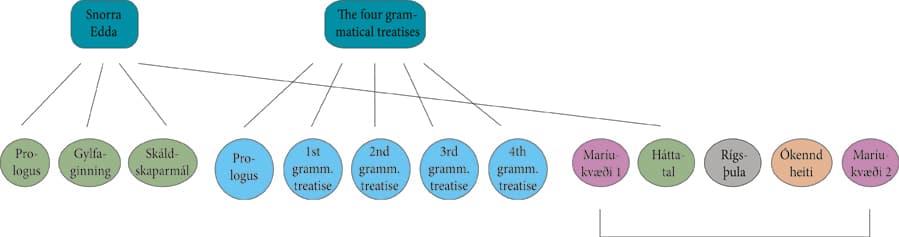
Based on an analysis of the contents of the texts, Háttatal should be placed as the fourth part of Snorra Edda, but the two parts of Mariukvæði have been analysed as separate items and thus not joined. This interpretation is shown in fig. 2.

Although fig. 2 gives a better representation of the text structure of this particular manuscript, we recommend that the individual parts of the manuscript are encoded in sequential order, as shown in fig. 1. In general, we believe that the encoding of a source should keep closely to the source itself and not impose unnecessary interpretations on it. Even if there are good reasons for regarding e.g. Háttatal as the fourth part of Snorra Edda, the transcription should show that it is not located as the fourth part in the manuscript and that this in fact may be intended by the scribe (or redactor).
The header of a multi-text source should specify the various parts of the source within
the
element. Here, each part is described as an item,
<msContents>
, and linked with an <msItem>
number to the relevant section in the
text itself. In the text, @id
elements identify the corresponding parts of the
source.<div>
If the source is encoded as recommended here, the text can be displayed in the sequence
of the source itself, i.e. as in fig. 1, or by following the
numbers, in the
order of its contents (as analysed by the transcriber/editor), i.e. as in fig. 2.@id
<TEI xmlns="http://www.tei-c.org/ns/1.0">
<teiHeader xml:lang="eng">
<fileDesc>
<titleStmt>
<title>AM 242 fol. (Codex Wormianus): an electronic edition</title>
<respStmt>
<resp>Transcription, lemmatisation and morphological encoding by
</resp>
<name><persName>Karl G. Johansson</persName>,
<orgName type="affiliation">University of Oslo</orgName></name>
</respStmt>
</titleStmt>
<editionStmt>
<p>First draft, <date when="2002-11-01">1 November 2002</date>.</p>
</editionStmt>
<publicationStmt>
<distributor>Medieval Nordic Text Archive</distributor>
<idno type="Menota">Ms. 2</idno>
<date when="2003-03-23">23 March 2003</date>
<availability status="restricted">
<p>This text is available for purposes of academic
research and teaching only. Re-distribution in any form without
prior permission is prohibited. Short extracts may be cited with
full acknowledgment of the source.</p>
</availability>
</publicationStmt>
<sourceDesc>
<msDesc>
<msIdentifier>
<country key="DK">Denmark</country>
<settlement>Copenhagen</settlement>
<repository>The Arnamagnæan Institute</repository>
<idno>AM 242 fol</idno>
<msName type="nickname" xml:lang="lat">Codex Wormianus
</msName>
</msIdentifier>
<msContents>
<msItem n="1">
<locus from="1v" to="35v">pp. 2-82 (including paper
leaves)</locus>
<title>Edda Snorra Sturlusonar</title>
<title type="abbreviated">SnE</title>
<textLang mainLang="oic">Old Icelandic</textLang>
<msItem n="1.1">
<locus from="1v" to="4v">pp. 2–8</locus>
<title>Prologus</title>
</msItem>
<msItem n="1.2">
<locus from="4v" to="20r">pp. 8-44</locus>
<title>Gylfaginning</title>
</msItem>
<msItem n="1.3">
<locus from="20v" to="35v">pp. 44-82</locus>
<title>Skáldskaparmál</title>
</msItem>
</msItem>
<msItem n="2">
<locus from="36r" to="54r">pp. 83-119</locus>
<title>The four grammatical treatises</title>
<title type="abbreviated">Gramm</title>
<textLang mainLang="oic">Old Icelandic</textLang>
<msItem n="2.1">
<locus from="36r" to="36r">p. 83</locus>
<title>Prologus</title>
<title type="abbreviated">GrammProl</title>
</msItem>
<msItem n="2.2">
<locus from="36v" to="39v">pp. 84-90</locus>
<title>First grammatical treatise</title>
<title type="abbreviated">Gramm1</title>
</msItem>
<msItem n="2.3">
<locus from="40r" to="41v">pp. 91-93</locus>
<title>Second grammatical treatise</title>
<title type="abbreviated">Gramm2</title>
</msItem>
<msItem n="2.4">
<locus from="41v" to="50r">pp. 94-111</locus>
<title>Third grammatical treatise</title>
<title type="abbreviated">Gramm3</title>
</msItem>
<msItem n="2.5">
<locus from="50r" to="54r">pp. 111-119</locus>
<title>Fourth grammatical treatise</title>
<title type="abbreviated">Gramm4</title>
</msItem>
</msItem>
<msItem n="3">
<locus from="54v" to="54v">p. 120</locus>
<title>Maríukvæði</title>
<textLang mainLang="oic">Old Icelandic</textLang>
</msItem>
<msItem n="1.4" defective="true">
<locus from="55r" to="60v">pp. 121-154 (including
paper leaves)</locus>
<title>Háttatal</title>
<title type="abbreviated">SnE</title>
<textLang mainLang="oic">Old Icelandic</textLang>
</msItem>
<msItem n="4" defective="true">
<locus from="61r" to="61v">pp. 155–156</locus>
<title>Rígsþula</title>
<title type="abbreviated">Edda</title>
<textLang mainLang="oic">Old Icelandic</textLang>
</msItem>
<msItem n="5" defective="true">
<locus from="62r" to="63r">pp. 167-169</locus>
<title>Ókennd heiti (Orms-eddu-brot)</title>
<textLang mainLang="oic">Old Icelandic</textLang>
</msItem>
<msItem n="6">
<locus from="63v" to="63v">p. 170</locus>
<title>Maríukvæði</title>
<textLang mainLang="oic">Old Icelandic</textLang>
</msItem>
</msContents>
<physDesc>
<objectDesc form="codex">
<supportDesc>
<support>
<p><material>Parchment</material>, but
with some <material>paper</material> leaves
added in the 17th century for the purpose of
completing the text (pp. 61-72, 121-138,
151-154, 157-166).</p>
</support>
<extent>85 leaves, including the younger paper
leaves; 280 mm (height) by 202 mm (width).</extent>
<foliation>
<p>The manuscript, including the younger
paper leaves, is paginated on the recto pages, 1-169.</p>
</foliation>
</supportDesc>
</objectDesc>
</physDesc>
<history>
<origin>
<p>Written in <origPlace>Iceland</origPlace> in
<origDate notBefore="1350" notAfter="1400">the second half of
the 14th century</origDate>; there are many
later additions, principally from the 17th century.</p>
</origin>
</history>
</msDesc>
</sourceDesc>
</fileDesc>
<encodingDesc>
<projectDesc>
<p>This manuscript text has been encoded according to the standard
set out in <title>The Menota handbook</title> (version 2.0), at
<ref target="http://www.aksis.uib.no/menota/guidelines">
http://www.aksis.uib.no/menota/guidelines</ref>
as of <date>2006-03-30</date>.</p>
</projectDesc>
<editorialDecl>
<correction status="high">
<p>This text has been proofread by <name>Karl G. Johansson</name>
<name type="affiliation"> University of Oslo</name>.</p>
</correction>
</editorialDecl>
</encodingDesc>
<profileDesc>
<langUsage>
<language ident="oic">Old Icelandic</language>
<language ident="onw">Old Norwegian</language>
<language ident="osw">Old Swedish</language>
<language ident="oic-onw">Old Icelandic with Old Norwegian traits</language>
<language ident="onw-oic">Old Norwegian with Old Icelandic traits</language>
</langUsage>
<handNotes>
<handNote xml:id="h1"/>
<handNote xml:id="h2"/>
</handNotes>
</profileDesc>
<revisionDesc>
<change>
<date>2008-01-09</date>
<name>Tone Merete Bruvik</name>,
<orgName type="affiliation">Aksis</orgName>:
Updated the header to make it valid according to the Menota P5 DTD.
</change>
<change>
<date>2006-04-18</date>
<name>Tone Merete Bruvik</name>, <orgName type="affiliation">Aksis</orgName>:
Changed the attribute use in the textLang element from xml:lang into mainLang.
</change>
<change>
<date>2006-03-30</date>
<name>Tone Merete Bruvik</name>, <orgName type="affiliation">Aksis</orgName>:
Revised the transcription in accordance with v. 2.0
of the Menota handbook and the corresponding Document Type Definition.
</change>
<change>
<date>2004-05-10</date>
<name>Karl G. Johansson</name>, <orgName type="affiliation">University
of Oslo</orgName>
Revised the transcription in accordance with v. 1.1 of the Menota handbook
and the corresponding Document Type Definition.
</change>
</revisionDesc>
</teiHeader>The body follows immediately after the header. This is where the actual transcription
is located. Note that
elements are used to organise the various parts of
the manuscript, referring to the divisons set out in the <div>
element
of the header.<msContents>
<text xml:lang="oic">
<body>
<div n="1.1">
<head>
<supplied>Prologus</supplied>
</head>
<p>The text of part 1.1 goes here.</p>
</div>
<div n="1.2">
<head>
<supplied>Gylfaginning</supplied>
</head>
<p>The text of part 1.2 goes here.</p>
</div>
<div n="1.3">
<head>
<supplied>Skáldskaparmál</supplied>
</head>
<p>The text of part 1.3 goes here.</p>
</div>
<div n="2.1">
<head>
<supplied>Prologus</supplied>
</head>
<p>The text of part 2.1 goes here.</p>
</div>
<div n="2.2">
<head>
<supplied>The first grammatical treatise</supplied>
</head>
<p>The text of part 2.2 goes here.</p>
</div>
<div n="2.3">
<head>
<supplied>The second grammatical treatise</supplied>
</head>
<p>The text of part 2.3 goes here.</p>
</div>
<div n="2.4">
<head>
<supplied>The third grammatical treatise</supplied>
</head>
<p>The text of part 2.4 goes here.</p>
</div>
<div n="2.5">
<head>
<supplied>The fourth grammatical treatise</supplied>
</head>
<p>The text of part 2.5 goes here.</p>
</div>
<div n="3">
<head>
<supplied>Maríukvæði (1)</supplied>
</head>
<p>The text of part 3 goes here.</p>
</div>
<div n="1.4">
<head>
<supplied>Háttatal</supplied>
</head>
<p>The text of part 1.4 goes here.</p>
</div>
<div n="4">
<head>
<supplied>Rígsþula</supplied>
</head>
<p>The text of part 4 goes here.</p>
</div>
<div n="5">
<head>
<supplied>Ókennd heiti</supplied>
</head>
<p>The text of part 5 goes here.</p>
</div>
<div n="6">
<head>
<supplied>Maríukvæði (2)</supplied>
</head>
<p>The text of part 6 goes here.</p>
</div>
</body>
</text>The source text is placed within the
element. The attribute <text>
specifies the language of the text (cp. @xml:lang
above). If the text
contains sporadic words or sentences in another language, e.g. Latin, the attribute
<msContents>
can be used to specify these exception from the rule, whether on the level of
the word, @xml:lang
, paragraph, <w>
or chapter, <p>
.<div>
The divisions of the text correspond to the list of
elements in
<msItem>
above, using the same numbers (1.1, 1.2, 1.3, 2.1, 2.2, etc.)<msContents>
The
element specifies the title of the work (or a part of it). If the
title is not stated in the source, the attribute type with the value supplied should
be used. If the title is stated as a rubric in the manuscript, the type attribute
should still be used, but with the value rubric.<head>
E.4 Downloading sample XML headers
We offer the two headers in this chapter for free downloading:
Download the header of Holm perg 6 fol as a sample XML file
Download the header of AM 242 fol as a sample XML file
Please note that some browsers may try and interpret and open this sample file. In order to download the file to your disk, use alt-click (Mac) or right-click (Windows) on your browser, unless your browser has other preferences.